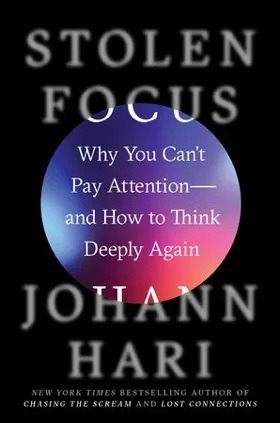
Stolen Focus: Summary and Evidence Check
Stolen Focus summary: Johann Hari's twelve causes of our attention problems, what he proposes, and which of his claims the research actually backs.
Some links on this page earn us a commission if you buy something, at no extra cost to you. It never affects which products we include or what we say about them. As an Amazon Associate we earn from qualifying purchases. More in our privacy policy.
Worth reading if
You want the systemic, political account of distraction: business models, working hours, childhood, rather than another list of productivity tips. It is an accessible tour of a lot of researchers’ ideas.
Skip it if
You want rigorous evidence, or you have ADHD or are deciding on treatment for a child. The book concedes there are no long-term studies of attention capacity, and its ADHD chapter leans on sceptics against the weight of the research.
What the book argues
Published in January 2022, the book starts from the feeling that sustained concentration has become harder, and argues that this is not a failure of willpower. Hari, a journalist, frames it as something taken from us by powerful outside forces, chief among them technology companies whose business model depends on capturing attention. Reviewers note that he spent several months offline while researching it.
The book is built around interviews with researchers, and its argument is that personal fixes, however useful, cannot solve what is a structural problem. Hari borrows the phrase "cruel optimism" for the idea that self-help can fix a systemic problem.
The twelve causes
Hari listed them himself in an interview with Thought Economics:
- The increase in speed, switching and filtering
- The crippling of our flow states
- The rise of physical and mental exhaustion
- The collapse of sustained reading
- The disruption of mind-wandering
- The rise of technology that can track and manipulate you
- The rise of cruel optimism
- The surge in stress and how it triggers vigilance
- The deterioration of our diets
- The rise of pollution
- The rise of ADHD and how we respond to it
- The confinement of children, physically and psychologically
What it proposes
The personal advice is modest: regular breaks from social media, walks without a phone, putting sleep first and doing one thing at a time. Hari is sceptical of the full digital detox as something people can sustain.
The larger proposals are collective, under the banner of an "attention rebellion": banning or reforming business models built on surveillance advertising, shorter working hours, freer childhoods, and questioning the pursuit of endless economic growth. Kirkus observed that some of these remedies risk becoming the same cruel optimism the book warns about.
How much of it holds up
The book’s broad picture, that constant switching has costs and that sleep, stress and overwork affect concentration, rests on solid research. The trouble is in the specifics. On one page the book concedes that no long-term studies track whether people’s ability to focus has actually declined, which is the premise of the title. Some of the most quotable figures come from weak or disowned sources, and the author keeps a public corrections page for errors found since publication. The claims below take the central ones in turn.
The key claims, checked
6 of the book’s central factual claims, and what the research says about each. The verdict describes the evidence, not the book.
Our ability to pay attention is collapsing, individually and collectively.
MixedFaster switching is documented: Gloria Mark’s studies found office workers averaged about three minutes on a task in 2004, and her later work reports about 47 seconds on one screen. Public attention to news topics also rises and fades faster than it did decades ago. But these measure how we spend attention, not our capacity for it, and the book itself concedes there are no long-term studies tracking changes in people’s ability to focus.
González & Mark, CHI (2004) · Gloria Mark, APA Speaking of Psychology · Lorenz-Spreen et al., Nature Communications (2019) · Stuart Ritchie, UnHerd (2022)
Being constantly interrupted costs about ten IQ points, a bigger effect than cannabis.
Not supportedThe figure comes from a 2005 study run for Hewlett-Packard by the psychologist Glenn Wilson. It was released to the press and never peer-reviewed, and the IQ part involved eight people. Wilson later said it had been widely misrepresented and did not prove much, and the cannabis comparison was not his. Across twelve lab studies, heavy media multitaskers show only a small link to distractibility.
John D. Cook, on his exchange with Wilson · Wiradhany & Nieuwenstein (2017)
We sleep far less than people used to, and the lost sleep is eroding our focus.
MixedThe mechanism holds: sleep deprivation reliably causes lapses in attention, the clearest finding in a meta-analysis of 70 studies. The historical decline does not. A review of 168 studies that measured adult sleep objectively between 1960 and 2013 found no trend in sleep duration over those decades.
Lim & Dinges, Psychological Bulletin (2010) · Youngstedt et al., Sleep Medicine Reviews (2016)
Shorter working weeks reduce the exhaustion and stress that wreck concentration.
Holds upThe largest trial so far covered 2,896 employees at 141 organisations in six countries. A four-day week with no loss of pay reduced burnout and improved job satisfaction and mental and physical health, partly through less fatigue and fewer sleep problems. The companies chose to take part and most outcomes were self-reported, and attention itself was not measured directly.
Rising ADHD is driven more by environment than the medical account allows, and stimulant treatment is overused.
MixedEnvironment plays a real part, and the book draws on researchers who study it. But twin, family and adoption studies put the heritability of ADHD at about 74%, and a network meta-analysis of 133 trials supports stimulant medication for short-term treatment in children and adults. A reader weighing treatment should not take this chapter as the balance of the evidence.
Faraone & Larsson, Molecular Psychiatry (2019) · Cortese et al., Lancet Psychiatry (2018)
Poor diet and air pollution are eroding our attention.
MixedReal associations exist. Long-term exposure to air pollution was linked to lower verbal and maths scores in a national Chinese sample, and a randomised trial found artificial food colours and a common preservative increased hyperactivity in children. The effects are modest, and nothing shows these factors explain a population-wide decline in attention.
Zhang, Chen & Zhang, PNAS (2018) · McCann et al., The Lancet (2007)
What the critics say
- Stuart Ritchie, psychologist and author of Science Fictions. Argues the book is heavy on anecdote and light on evidence, that it admits there are no long-term studies of attention, that it contains factual errors, and that much of it repeats earlier popular books. UnHerd, January 2022
- Hugh Linehan, The Irish Times. Argues that uncritical media coverage of the book fed a social panic about attention that its evidence did not justify. The Irish Times, January 2022
- Karlin Lillington, The Irish Times. A mostly positive review that finds it compelling and accessible, while saying it sometimes oversimplifies and that the late chapters on children and ADHD are detours. The Irish Times, January 2022
- Sune Lehmann, a researcher the book cites. When a historian accused Hari of misusing his study of collective attention, Lehmann defended the book’s treatment of it as careful. Lehmann’s blog, January 2022
Read next
- Attention SpanGloria Mark. Attention is a finite resource that needs deliberate rhythm, not constant peak focus.
- The Sirens' CallChris Hayes. Your attention is not being wasted, it is being mined. The distinction changes what a solution looks like.
- Deep WorkCal Newport. The ability to focus without distraction is becoming increasingly rare and increasingly valuable.
- How Social Media Is Quietly Destroying Your Ability to Think DeeplyOur guide to the question the book is about.
Sources
- Penguin Random House, Stolen Focus
- Stolen Focus, corrections page
- Thought Economics, interview with Johann Hari (2022)
- Kirkus Reviews, Stolen Focus
Written from the book’s published description, the author’s own statements, named reviews and the primary research, not from a first-hand reading. Where a claim is summarised, the page says whose account it is.