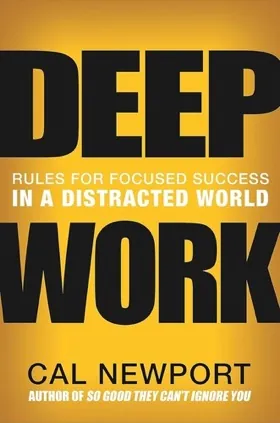
Deep Work: Summary and Evidence Check
Deep Work summary: Cal Newport's four rules for focused work, the ideas behind them, and which of the book's research claims have held up since 2016.
Some links on this page earn us a commission if you buy something, at no extra cost to you. It never affects which products we include or what we say about them. As an Amazon Associate we earn from qualifying purchases. More in our privacy policy.
Worth reading if
Your work is making hard things, such as code, research, writing or analysis, and you have some control over your calendar. The tactics are concrete: time-blocking, rituals for starting deep work, and a set routine for ending the day.
Skip it if
Your job is reactive by design, such as managing people, shift or frontline work, or you are a junior employee or carer without control of your schedule. Several reviewers note the advice assumes a flexibility many readers do not have.
What the book argues
Published by Grand Central in January 2016, the book rests on what Newport calls the deep work hypothesis, set out in his launch post: concentrated, undistracted work is becoming more valuable at the same time as it is becoming rarer, so anyone who cultivates it has an advantage. Newport is a computer science professor at Georgetown, and the argument is aimed at knowledge workers.
How the book is organised
The first part makes the case in three chapters: deep work is valuable, it is rare, and it is meaningful. The economic argument, as reviewers summarise it, draws on Brynjolfsson and McAfee's account of which groups gain as technology advances: highly skilled workers, stars in their field, and owners of capital.
The second part gives four rules:
- Work deeply. Build routines and rituals so concentration does not depend on willpower in the moment. Summaries of the book describe four ways to schedule it, from cutting out nearly all shallow work to fitting deep sessions into whatever gaps appear.
- Embrace boredom. Practise tolerating the absence of stimulation rather than reaching for your phone at every pause, so that focus is available when you want it.
- Quit social media. Adopt a tool only if its benefits to your core goals clearly outweigh its costs, rather than because it offers some possible benefit.
- Drain the shallows. Schedule every minute of the working day in blocks, and cap the time spent on email, meetings and admin.
The tactics people keep
Two ideas from the book have outlasted the argument around them. Time-blocking, planning the day as a sequence of blocks rather than a to-do list, is now standard productivity advice. The shutdown ritual, reviewing every open task at the end of the day so work stops occupying your mind in the evening, predates the book: Newport first wrote about it in 2009.
The research claims supporting the book have had a rougher decade. Several of the studies it draws on, on deliberate practice and on willpower, have been reanalysed or failed to replicate since 2016. The advice largely survives that, because it is useful on its own terms; some of the stated reasons for it do not.
The key claims, checked
5 of the book’s central factual claims, and what the research says about each. The verdict describes the evidence, not the book.
Switching tasks leaves "attention residue" that lowers performance on the next one.
MixedThe effect has appeared repeatedly in lab experiments from Sophie Leroy’s research group, including follow-up work showing a quick plan for resuming the unfinished task reduces it. It fits the wider research on task-switching costs. No independent replication was found, so it rests mainly on one programme of lab studies.
Leroy, OBHDP (2009) · Leroy & Glomb, Organization Science (2018)
Deliberate, focused practice is what separates experts from everyone else.
MixedFocused practice clearly helps, but a meta-analysis found it explained 26% of differences in performance in games, 21% in music, 18% in sports, 4% in education and under 1% in professions, the category closest to knowledge work. Anders Ericsson, whose work the claim comes from, disputed how that analysis defined deliberate practice.
Macnamara, Hambrick & Oswald, Psychological Science (2014) · Ericsson, Psychological Research (2020)
About four hours a day is the limit for intense, deep concentration.
Not supportedThe figure traces to a 1993 study of violinists and its review of earlier research on practice, not to a tested limit on knowledge work. A 2019 replication of the violinist study did not reproduce its core finding, and the best violinists in it reported less solo practice than the good ones. It may still be a sensible rule of thumb; it is not a measured ceiling.
Ericsson, Krampe & Tesch-Römer, Psychological Review (1993) · Macnamara & Maitra, Royal Society Open Science (2019)
Open offices and constant interruption undermine focused work.
Holds upTwo field studies found face-to-face interaction fell by about 70% after moves to open offices, while email and messaging rose, and survey data show enclosed offices beat open plan on noise and privacy. Interrupted workers in one experiment finished tasks faster without losing quality, but reported more stress and effort: the cost shows up in strain as much as in output.
Bernstein & Turban, Phil. Trans. R. Soc. B (2018) · Kim & de Dear, J. Environmental Psychology (2013) · Mark, Gudith & Klocke, CHI (2008)
Willpower is a limited resource that gets used up over the day.
Not supportedThe book draws on the "ego depletion" research, as reviewers have noted. A replication across 23 labs and 2,141 participants found an effect close to zero. The book’s practical answer, building routines so focus does not depend on willpower, holds up well without it.
Hagger et al., Perspectives on Psychological Science (2016) · Commoncog, on Deep Work (2018)
What the critics say
- Tiago Forte, Forte Labs. Argues that cutting out everything that is not deep is too simple for most people, since loose networks, online communities and passing awareness of other fields have real value. Forte Labs, February 2016
- Commoncog. Notes that parts of the book’s science, such as ego depletion, have failed to replicate, and that the advice fits managers and other non-maker roles poorly. Commoncog, September 2018
- Ana Canhoto, social scientist. Argues the advice assumes a flexibility that junior staff, open-office workers and carers lack, and that the book defines valuable work narrowly as individual achievement. anacanhoto.com, April 2019
Read next
- Digital MinimalismCal Newport. Less is more: be intentional about which technologies you let into your life.
- Four Thousand WeeksOliver Burkeman. You will never get on top of everything: choose what to neglect.
- RestAlex Soojung-Kim Pang. Deliberate rest is a skill, and it is what makes deep focus sustainable.
- How Social Media Is Quietly Destroying Your Ability to Think DeeplyOur guide to the question the book is about.
Sources
Written from the book’s published description, the author’s own statements, named reviews and the primary research, not from a first-hand reading. Where a claim is summarised, the page says whose account it is.