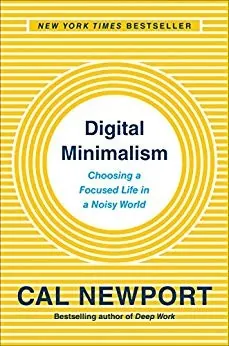
Digital Minimalism: Summary and Evidence Check
Digital Minimalism summary: Cal Newport's philosophy, the 30-day digital declutter he ran with 1,600 readers, and what the research says about it.
Some links on this page earn us a commission if you buy something, at no extra cost to you. It never affects which products we include or what we say about them. As an Amazon Associate we earn from qualifying purchases. More in our privacy policy.
Worth reading if
You feel your phone and social media use has become compulsive and want a structured reset rather than a list of tips. The declutter, and its insistence that you replace what you remove, is the part people act on.
Skip it if
You look after young children or have little free time. Reviewers note that the demanding leisure the book prescribes assumes time and childcare many readers lack. If you want rigorous evidence, trials of social media breaks find real but small effects.
See Digital Minimalism on Amazon
What the book argues
Published by Portfolio in February 2019, the book is Newport’s follow-up to Deep Work, turning from working life to personal life. His own description is that people signed up for technologies casually, one convenience at a time, and ended up with a relationship to their devices that lowers their quality of life. The fix he proposes is not less technology in general but deliberate technology: keep what clearly serves something you care about and drop everything else.
How the book is organised
The first part lays the foundations. It opens with what Newport calls a lopsided arms race between tech companies and users, and sets out three principles, summarised in the Los Angeles Review of Books as: clutter is costly, optimisation is important, and intentionality is satisfying. It ends with the digital declutter.
The second part covers practices:
- Spend time alone. Newport coins "solitude deprivation" for spending almost no time alone with your own thoughts, free of input from other minds.
- Don’t click like. Low-effort digital signals are not a substitute for conversation, and he argues only real conversation, including calls and video, should count towards keeping a relationship going.
- Reclaim leisure. Prefer demanding, structured leisure such as craft, physical activity or social activity over passive consumption.
- Join the attention resistance. Practical tactics for using the attention economy on your own terms.
The 30-day declutter
The declutter is the book’s method. For 30 days you step away from every optional technology, then reintroduce only the tools you can justify, with rules about how you use them. Newport argues an abrupt break works better than gradually cutting back.
He tried it out before the book was published. In January 2018 he invited his mailing list to take part, expecting 40 or 50 people, and more than 1,600 signed up. The results he reports are participants’ own accounts: new hobbies, much more reading, closer relationships. That makes it a useful field test of whether people can do it, but not a controlled study of whether it works, since there was no comparison group and the volunteers were already his readers.
The key claims, checked
5 of the book’s central factual claims, and what the research says about each. The verdict describes the evidence, not the book.
Social apps are built around intermittent rewards and the drive for social approval.
Holds upAn analysis of more than a million posts found people’s posting followed the patterns of reward learning, posting more often when they got more likes. In teenagers, seeing photos with many likes activated the brain’s reward circuitry. That designers set out to exploit this rests on insider testimony rather than studies, but the reward dynamics themselves are measured.
Lindström et al., Nature Communications (2021) · Sherman et al., Psychological Science (2016)
Too little time alone with your thoughts harms wellbeing.
MixedSolitude has measurable effects, calming people as well as lowering their excitement, depending on whether it is chosen. People also underestimate how enjoyable plain thinking is, and many find even a few minutes alone with their thoughts unpleasant. No study found shows that phones cause a harmful lack of solitude.
Nguyen, Ryan & Deci, PSPB (2018) · Hatano et al., JEP: General (2022) · Wilson et al., Science (2014)
Low-quality online interaction crowds out richer time with people offline.
MixedPassive scrolling has been shown to lower mood, with envy as the mechanism. But a longitudinal study of 2,774 people found no evidence that social media displaces face-to-face time with close friends and family, while a trial of Facebook deactivation found people did spend more time socialising offline.
Verduyn et al., JEP: General (2015) · Hall, Kearney & Xing (2019) · Allcott et al., AER (2020)
A 30-day break resets your habits and improves your wellbeing.
MixedTrials published after the book broadly back the idea of a break: four weeks off Facebook raised wellbeing and kept use lower afterwards, and limiting social media for three weeks reduced loneliness and depression. A 2025 meta-analysis of 32 trials found the average effect small. The 30-day figure itself has no special basis: habit formation took anywhere from 18 to 254 days in the best-known study.
Allcott et al., AER (2020) · Hunt et al., JSCP (2018) · Burnell et al., SSM – Mental Health (2025) · Lally et al., EJSP (2010)
Active, demanding leisure makes people happier than passive consumption.
Holds upAcross 1,399 people, taking part in more enjoyable leisure activities was associated with better psychological and physical health. The finding is observational, and it does not directly test the book’s split between demanding and passive leisure, but it points the same way.
What the critics say
- Laura Vanderkam, time-management author. Agrees with the direction but notes a parenting blind spot: the demanding leisure Newport recommends needs someone to watch the children, while a screen needs nothing. lauravanderkam.com, February 2019
- Leslie A. Wicke, Modern Reformation. Calls it a strategy rather than a philosophy, finds "personal values" left vague, and says the later chapters assume time and resources many readers do not have. Modern Reformation, July 2019
- Taylor Fayle, Los Angeles Review of Books. A largely positive review that endorses the case for an abrupt break over gradual change. LARB, June 2019
Read next
- Deep WorkCal Newport. The ability to focus without distraction is becoming increasingly rare and increasingly valuable.
- How to Break Up with Your PhoneCatherine Price. Your phone is designed to be addictive, but you can rewire your relationship with it in just one month.
- Bored and BrilliantManoush Zomorodi. Boredom is not the enemy. It's the birthplace of your best ideas.
- How to Do a Digital Declutter (Without Reorganising Everything)Our guide to the question the book is about.
Sources
- Penguin Random House, Digital Minimalism
- Cal Newport, announcing Digital Minimalism
- Cal Newport, on the declutter experiment
- Los Angeles Review of Books, review (2019)
Written from the book’s published description, the author’s own statements, named reviews and the primary research, not from a first-hand reading. Where a claim is summarised, the page says whose account it is.