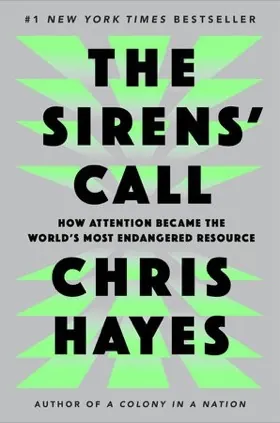
The Sirens' Call: Summary and Evidence Check
The Sirens' Call summary: Chris Hayes on attention as the scarce resource of our age, his labour analogy, and how its central claims hold up.
Some links on this page earn us a commission if you buy something, at no extra cost to you. It never affects which products we include or what we say about them. As an Amazon Associate we earn from qualifying purchases. More in our privacy policy.
Worth reading if
You want the big-picture account: the economics, history and politics of attention rather than a guide to managing your own. It is especially strong on how media and politics changed, from someone who works inside cable news.
Skip it if
You want practical steps. Several reviewers single out the remedies as the weakest part. And the book poses the question of how harmful social media is rather than settling it.
See The Sirens' Call on Amazon
What the book argues
Published by Penguin Press in January 2025, the book frames attention as a commodified resource extracted from us, in the way labour was commodified in the nineteenth century. Hayes, a cable news host and the author of Twilight of the Elites and A Colony in a Nation, argues that in about a decade a few technology companies dismantled the line between public and private life.
The title comes from the Odyssey: Odysseus has his crew plug their ears with wax and ties himself to the mast so he can hear the sirens without steering towards them. The image, of needing outside restraint against a pull you cannot resist alone, runs through the book.
The key ideas
- Three kinds of attention. In interviews Hayes distinguishes voluntary attention, which you choose to direct; involuntary attention, which is grabbed, as by a siren or a crying baby; and social attention, the desire to be seen and recognised. Involuntary attention is easier to seize than to hold, which pushes platforms towards sensation.
- Scarcity. He builds on the economist Herbert Simon, who argued in 1971 that a wealth of information creates a poverty of attention.
- Alienation. A chapter applies Marx’s idea that commodified labour alienates the worker to today’s attention markets. This is the book’s most original move and the most contested: it is an interpretation, not something evidence can confirm or refute.
- Politics. Hayes presents Donald Trump as the politician who most fully grasped the new rules, in which visibility of any kind is worth more than favourable coverage.
What it proposes
The remedies come at three levels, as reviewers describe them: personal, such as basic phones, print newspapers and leaving the phone at home; collective, including what Hayes calls attentional farmers’ markets; and political, including regulation modelled on labour law, possible legal limits on screen and app time, restructuring platforms for public benefit, and antitrust.
The book reached number one on the New York Times nonfiction list and was on Barack Obama’s 2025 summer reading list.
The key claims, checked
4 of the book’s central factual claims, and what the research says about each. The verdict describes the evidence, not the book.
Herbert Simon foresaw in 1971 that "a wealth of information creates a poverty of attention".
Holds upThe line comes from Simon’s essay "Designing Organizations for an Information-Rich World", published in 1971, and it is the standard origin cited for the idea of an attention economy.
People’s ability to sustain focus is weakening.
MixedHow people spend attention has clearly changed: Gloria Mark’s studies found average time on one screen before switching fell from about two and a half minutes in 2004 to about 47 seconds, and the share of Americans reading for pleasure on a given day fell from 28% in 2004 to 16% in 2023. Much less shows that the underlying capacity to focus has declined, and the historian Daniel Immerwahr notes that nearly every new medium has prompted the same fear.
Gloria Mark, APA Speaking of Psychology · Bone et al., iScience (2025) · Daniel Immerwahr, The New Yorker (2025)
Donald Trump won by mastering attention, where visibility of any kind beats favourable coverage.
MixedHis dominance of coverage is well documented: the media-tracking firm mediaQuant valued the free coverage he earned in the year to March 2016 at about $1.9 billion, more than twice Hillary Clinton’s $746 million. That attention alone explains his success is an interpretation, and the critic Laura Marsh argues it underrates the possibility that voters chose his message deliberately.
PolitiFact (2016) · Laura Marsh, New York Review of Books (2025)
Social media may be closer to cigarettes than to comic books, harmful enough to justify regulation.
MixedHayes poses this as a question, but his proposals lean towards the cigarettes answer. The research is genuinely divided: large studies find the association between technology use and adolescent wellbeing small, and researchers dispute whether the causal evidence supports the stronger claims.
Orben & Przybylski, Nature Human Behaviour (2019) · Candice Odgers, Nature (2024)
What the critics say
- Daniel Immerwahr, historian, The New Yorker. Calls it perhaps the most sophisticated book in its genre, but argues the panic over lost attention is itself a distraction: the question is what people attend to, not whether they can. The New Yorker, January 2025
- Laura Marsh, New York Review of Books. Finds the remedies inadequate and the account of Trump’s rise oversimplified. NYRB, March 2025
- Rhoda Feng, The American Prospect. Calls it a useful contribution but argues sovereignty over your attention is a better frame than scarcity, and finds the optimism about remedies somewhat forced. The American Prospect, January 2025
- Andrew DeMillo, Associated Press. A favourable review that praises Hayes’s candour about his own role in cable news, while finding the remedies incomplete. AP via KQED, February 2025
Read next
- The Attention MerchantsTim Wu. Your attention has been a traded commodity for two centuries.
- How to Do NothingJenny Odell. Resisting the attention economy is about what you give attention to, not just less screen time.
- Stolen FocusJohann Hari. Our attention crisis isn't just personal failure. It's systemic, and we need both individual and collective solutions.
- How to Stop Doomscrolling: Six Tactics That Actually WorkOur guide to the question the book is about.
Sources
- Penguin Random House, The Sirens’ Call
- The Sirens’ Call, author’s site
- Volts, interview with Chris Hayes (2025)
- Kirkus Reviews, The Sirens’ Call
- Literary Hub, Obama’s 2025 summer reading list
Written from the book’s published description, the author’s own statements, named reviews and the primary research, not from a first-hand reading. Where a claim is summarised, the page says whose account it is.