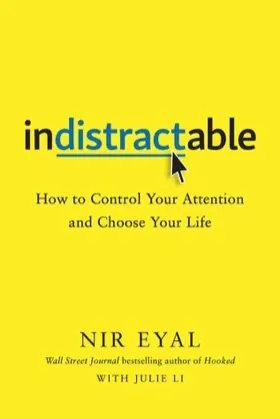
Indistractable: Summary and Evidence Check
Indistractable summary: Nir Eyal's four-part model for controlling distraction, the tactics behind it, and what the research says about each one.
Some links on this page earn us a commission if you buy something, at no extra cost to you. It never affects which products we include or what we say about them. As an Amazon Associate we earn from qualifying purchases. More in our privacy policy.
Worth reading if
You want a practical system for your own attention: timeboxing, notification changes and precommitment pacts. There are also sections for managers dealing with workplace culture and for parents.
Skip it if
You want a critique of the attention economy itself; the book puts responsibility on the user, which is the main criticism of it. And if your use is genuinely compulsive and damaging, a self-help framework is not a substitute for professional help.
What the book argues
Published by BenBella in September 2019 and written with Julie Li, the book reframes distraction as an unhealthy escape from bad feelings. Eyal’s line is that time management is pain management: people reach for their phones not because the phone is irresistible but because something else is uncomfortable. An updated edition in November 2025 added material on remote work and video calls.
The book reads differently in light of its author. Eyal’s previous book, Hooked (2014), taught product teams how to build habit-forming apps. Critics have pointed out the irony of the same author now writing the guide to resisting them. Eyal has said he stands by both books.
The four-part model
Eyal’s four steps organise the book:
- Master internal triggers. Notice the feeling that precedes a distraction and learn to sit with it, for instance by waiting ten minutes before giving in to an urge.
- Make time for traction. Timebox your calendar, including time for relationships and yourself as well as work. Anything is a distraction only relative to what you planned to do.
- Hack back external triggers. Turn off or remove the notifications, meetings and messages that interrupt you without serving you.
- Prevent distraction with pacts. Precommit in advance with effort pacts, which make distraction harder, price pacts, which make it costly, and identity pacts, where you see yourself as someone who does not get distracted.
The later sections apply the model to workplaces, where Eyal argues constant distraction is a symptom of a dysfunctional culture, and to children and relationships.
A pact in practice
Eyal has written that he used a $10,000 price pact to finish the manuscript. It is a good illustration of the approach, and of its limit: price pacts are powerful for the minority of people willing to sign one.
The key claims, checked
5 of the book’s central factual claims, and what the research says about each. The verdict describes the evidence, not the book.
All behaviour is driven by the desire to escape discomfort.
Not supportedEyal states this as the premise of the book. Escape and avoidance are well-established drivers of behaviour in psychology, but no research establishes that they drive all of it. It works as a useful lens for noticing why you reach for your phone, not as a finding.
Riding out an urge, rather than acting on it, weakens the habit.
MixedThe technique comes from addiction research. In a trial of 123 student smokers, brief "urge surfing" instructions did not reduce urges but did cut the number of cigarettes smoked over the following week, and in another small trial 31% of smokers given mindfulness training had quit at 17 weeks, against 6% on a standard programme. All of this is about smoking, and the ten-minute timing itself has not been tested.
Bowen & Marlatt, Psychology of Addictive Behaviors (2009) · Brewer et al., Drug and Alcohol Dependence (2011)
Deciding in advance exactly when you will do something makes you far more likely to do it.
Holds upThe closest research is on implementation intentions, plans of the form "when X happens, I will do Y". A meta-analysis of 94 tests found a medium-to-large effect on reaching goals. Timeboxing as a calendar method has not been tested directly, but it rests on the same mechanism.
Gollwitzer & Sheeran, Advances in Experimental Social Psychology (2006)
Precommitment pacts, such as putting money at stake, help people follow through.
Holds upIn a trial where smokers could deposit their own money and lose it if they failed a test, being offered the contract raised quit rates by three percentage points, still visible a year later. A large US trial found deposit contracts were more effective for those who took them, but only 13.7% accepted one. They work; few people choose them. A widely cited study of self-imposed deadlines in this area, by Ariely and Wertenbroch, was retracted in September 2026 and is not relied on here.
Giné, Karlan & Zinman, AEJ: Applied (2010) · Halpern et al., NEJM (2015) · Retraction Watch (2026)
Willpower is not a limited resource, and believing it is makes it run out.
MixedEyal rejects the idea that willpower gets used up, and the evidence broadly backs him: a replication across 23 labs found the depletion effect close to zero. But the second half, that your beliefs about willpower decide whether you tire, failed its own preregistered replication in 2023.
Hagger et al., Perspectives on Psychological Science (2016) · Carruth, Ramos & Miyake, PLOS One (2023) · Nir Eyal, on ego depletion
What the critics say
- James Williams, former Google strategist and author of Stand Out of Our Light. Argues the book lets technology off the hook: distraction lives in the interface between a person and a product, and design shares the blame. The Guardian, October 2019
- Nellie Bowles, The New York Times. Reports critics’ view that the people who built habit-forming technology are now selling the cure, and that self-control books distract from the bigger problem of design. The New York Times, October 2019
- Sean Illing, Vox. Challenges Eyal directly, in a recorded debate, on his claim that big tech is not addictive. Vox Conversations, August 2019
Read next
- HookedNir Eyal. Trigger, action, variable reward, investment, the loop behind every feed.
- IrresistibleAdam Alter. Addiction is designed into products, not a personal failing.
- Dopamine NationDr. Anna Lembke. Pleasure and pain are processed in the same part of the brain. Too much pleasure leads to pain.
- Why You Procrastinate on Your Phone (It Isn't a Time Management Problem)Our guide to the question the book is about.
Sources
- BenBella Books, Indistractable
- BenBella Books, Indistractable updated edition
- Nir Eyal, how to be indistractable
- Nir Eyal, Psyche guide
Written from the book’s published description, the author’s own statements, named reviews and the primary research, not from a first-hand reading. Where a claim is summarised, the page says whose account it is.