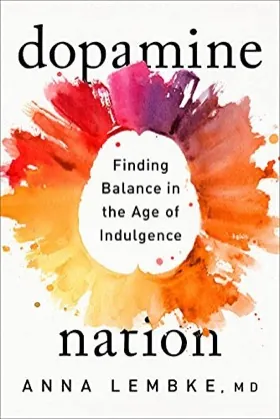
Dopamine Nation: Summary and Evidence Check
Dopamine Nation summary: Anna Lembke's pleasure-pain balance, her 30-day dopamine fast, and how well the neuroscience behind them holds up.
Some links on this page earn us a commission if you buy something, at no extra cost to you. It never affects which products we include or what we say about them. As an Amazon Associate we earn from qualifying purchases. More in our privacy policy.
Worth reading if
You have a habit you feel you overdo, whether that is your phone, food, gaming or something else, and want a concrete experiment to run: a four-week break, with a framework for what to do before and after it.
Skip it if
You want an accurate account of the neuroscience; the book’s dopamine-as-pleasure model is simpler than the current research. And if you are physically dependent on alcohol or a drug, stopping abruptly can be dangerous. Talk to a doctor before any abstinence experiment.
What the book argues
Published by Dutton in 2021, the book is built on a single image. Lembke describes pleasure and pain as two sides of a balance processed in overlapping parts of the brain. A pleasure tips the balance one way, and the brain then pushes back towards pain to level it. With repetition, she argues, the pleasure gets weaker and shorter while the painful after-effect grows stronger and longer: tolerance, craving and, eventually, a baseline that feels bad without the thing you were using.
Her diagnosis of modern life follows from that. When strong rewards are cheap, constant and always within reach, the balance spends most of its time tipped towards pain. Her own site calls the smartphone a modern-day hypodermic needle for this reason.
How the book is organised
The book is in three parts, according to library catalogue records: the pursuit of pleasure, self-binding, and the pursuit of pain. The first sets out the pleasure-pain model. The second covers self-binding, meaning limits you set in advance. The third argues for deliberately choosing some discomfort, and for radical honesty and what she calls prosocial shame, ideas that a Stanford reviewer notes draw on twelve-step programmes as well as behavioural science. Kirkus describes the step-by-step framework the book walks through, spelled out as DOPAMINE: data, objectives, problems, abstinence, mindfulness, insight, next steps and experiment.
The dopamine fast
The best-known recommendation is a four-week break from whatever you overuse. Lembke says people typically feel worse before they feel better, with cravings strongest in the first ten to fourteen days, and in a 2025 interview she described the break as an experiment that creates distance and information, not a cure. That framing is more careful than the popular version of the idea, which treats 30 days as a switch that resets the brain.
The author
Lembke is professor of psychiatry at Stanford and runs its addiction medicine dual diagnosis clinic, according to her Stanford profile. She testified to Congress on opioid overprescribing in 2015 and appeared in the Netflix documentary The Social Dilemma.
The key claims, checked
5 of the book’s central factual claims, and what the research says about each. The verdict describes the evidence, not the book.
Pleasure and pain are processed in the same parts of the brain.
Holds upA widely cited review found extensive overlap between the brain regions and chemical systems involved in pain and in pleasure, including the opioid and dopamine systems, and showed the two dampen each other. The balance itself is a teaching metaphor rather than a finding, and overlap is common in the brain, but the underlying claim is sound.
Any repeated pleasure builds tolerance, with a growing painful after-effect.
MixedThe opponent-process model behind this is decades old and well established for addictive drugs, where the brain adapts to repeated use and the after-effects grow. Extending it to any pleasurable experience goes beyond what those studies tested.
Solomon & Corbit, Psychological Review (1974) · Koob & Le Moal, Neuropsychopharmacology (2001)
Dopamine is the common currency of pleasure and of addiction.
MixedDopamine clearly matters in addiction, but current research ties it to wanting, the pull towards a reward, rather than liking, the pleasure itself. And not every addictive drug works through it: a 40-year review found strong evidence for stimulants, some for alcohol, and little or none for opiates and cannabis.
Berridge & Robinson, American Psychologist (2016) · Nutt et al., Nature Reviews Neuroscience (2015)
Thirty days of abstinence resets the brain’s reward pathways.
Not supportedNo study ties 30 days to a neural reset. In one small study of methamphetamine users, dopamine transporter levels recovered only after 12 to 17 months. Short breaks do help in their own right: four weeks off Facebook raised wellbeing and cut later use, and two weeks with mobile internet blocked improved wellbeing and sustained attention. The break is worth trying; the reset is the part that is not established.
Volkow et al., Journal of Neuroscience (2001) · Allcott et al., AER (2020) · Castelo et al., PNAS Nexus (2025)
Smartphones are addictive in the way drugs are.
MixedSome behavioural addictions are formally recognised: the WHO lists gaming disorder, and says it affects only a small proportion of gamers. Smartphone and social media use are not classified as disorders, and researchers argue "problematic use" is the more accurate term, because the harms for most people do not reach the severity of addiction.
WHO, gaming disorder · Panova & Carbonell, Journal of Behavioral Addictions (2018)
What the critics say
- Jesse Meadows, writer. Argues the book relies on an outdated dopamine-as-pleasure model and carries a moralising message about hardship that ignores who can afford to seek it. Sluggish, July 2023
- Kirkus Reviews. A positive review that calls the book’s framework a sensible formula for treatment. Kirkus, 2021
- Amer Raheemullah, Stanford School of Medicine. Recommends it to clinicians, and notes its blend of twelve-step ideas with behaviour-change science. He works at the same institution as the author. Cambridge Quarterly of Healthcare Ethics, 2022
Read next
- IrresistibleAdam Alter. Addiction is designed into products, not a personal failing.
- HookedNir Eyal. Trigger, action, variable reward, investment, the loop behind every feed.
- Digital MinimalismCal Newport. Less is more: be intentional about which technologies you let into your life.
- The Dopamine Trap: Why Your Brain Treats Your Phone Like a Slot MachineOur guide to the question the book is about.
Sources
- Penguin Random House, Dopamine Nation
- Anna Lembke, Stanford profile
- Anna Lembke, Dopamine Nation page
- NPR, interview with Anna Lembke
- Korea Biomedical Review, interview (2025)
Written from the book’s published description, the author’s own statements, named reviews and the primary research, not from a first-hand reading. Where a claim is summarised, the page says whose account it is.