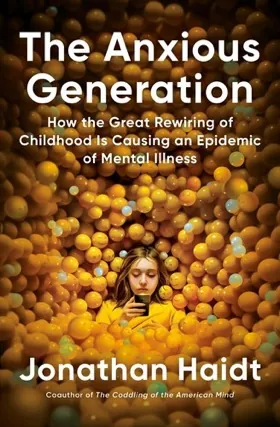
The Anxious Generation: Summary and Evidence Check
The Anxious Generation summary: Haidt's case that phones rewired childhood, his four norms, and which of his central claims the research supports.
Some links on this page earn us a commission if you buy something, at no extra cost to you. It never affects which products we include or what we say about them. As an Amazon Associate we earn from qualifying purchases. More in our privacy policy.
Worth reading if
You are deciding when your child gets a smartphone or social media, or you run a school weighing a phone policy. The four norms are the most concrete version of the argument in circulation, and knowing them is useful whatever you conclude about the causes.
Skip it if
You want a neutral account of the research. The book argues one side of a live dispute. If you read it, read Candice Odgers’ review in Nature and the National Academies report alongside it.
See The Anxious Generation on Amazon
What the book argues
The book, published by Penguin Press in March 2024, makes a two-part case. The first part is that adolescent mental health fell sharply in the early 2010s, with rates of depression, anxiety, self-harm and suicide more than doubling on some measures. The second is that the timing points to a cause: the years when smartphones and social media apps became the normal way for teenagers to spend their time.
Haidt names two changes rather than one. Children were overprotected in the real world, losing the free and sometimes risky play that he argues builds resilience, and underprotected online, where they were given unsupervised access to platforms designed to hold attention.
How the book is organised
The book is built in four parts, according to library catalogue and book-club listings of its contents.
- A tidal wave. The data on the rise in adolescent anxiety and depression from around 2010 to 2015.
- The decline of the play-based childhood. Why children need unsupervised play, and how overprotection since the 1980s delayed independence.
- The rise of the phone-based childhood. Four "foundational harms": social deprivation, sleep deprivation, attention fragmentation and addiction. Separate chapters argue that social media harms girls more, and look at what is happening to boys.
- Collective action. What governments, tech companies, schools and parents can do.
The four norms
The prescriptions are framed as a collective-action problem: one family acting alone leaves its child isolated, so the norms only work if many families adopt them. Haidt’s campaign site lists the four norms:
- No smartphones before high school, around age 14. A basic phone for calls and texts is fine before then.
- No social media before 16.
- Phone-free schools, with phones locked away for the whole school day.
- Far more independence, free play and responsibility in the real world.
Why the book matters beyond its argument
Few books about research have moved policy this quickly. The publisher reports more than two million copies sold. In South Australia, Premier Peter Malinauskas has said his wife read the book in early 2024 and urged him to act, which fed into Australia’s ban on social media for under-16s, in force since December 2025.
That influence is also why the evidence check below matters. The book’s first claim, that teenagers became markedly more anxious and depressed, is well documented. The claim that phones and social media are the cause is the contested one, and researchers who have read the same studies disagree about it in print.
The key claims, checked
5 of the book’s central factual claims, and what the research says about each. The verdict describes the evidence, not the book.
Adolescent mental health declined sharply in the early 2010s, especially among girls.
Holds upUS surveillance data show the trend clearly: the share of high-school girls reporting persistent sadness or hopelessness rose from 35% in 2011 to 57% in 2021, and major depressive episodes among girls roughly doubled between 2009 and 2019. The girls’ figure eased to 53% in 2023. How much of the rise reflects changes in screening and reporting is still debated, but the direction and timing are not.
CDC, YRBS 2011–2021 · Daly, Journal of Adolescent Health (2022) · CDC, YRBS 2023 results
Smartphones and social media are a major cause of that decline, not merely correlated with it.
MixedSome studies with causal designs point to harm: the staggered rollout of Facebook across US colleges was followed by worse student mental health. But large analyses find the association between technology use and teenage wellbeing is small, explaining at most 0.4% of the variation in one study of 355,000 adolescents, and a study across 72 countries found no link between Facebook adoption and worse wellbeing. The US National Academies concluded in 2023 that the evidence does not establish population-level causation.
Braghieri, Levy & Makarin, AER (2022) · Orben & Przybylski, Nature Human Behaviour (2019) · Vuorre & Przybylski, Royal Society Open Science (2023) · National Academies (2023)
Experiments show that cutting back on social media improves mental health.
MixedThe experimental record depends on how it is analysed. A 2024 meta-analysis of 27 experiments found an effect not statistically different from zero. A 2025 reanalysis of the same literature found that breaks shorter than a week slightly worsened outcomes while breaks of a week or more slightly improved them. Many of these trials recruited university students and adults rather than the younger teenagers the book is about.
Ferguson, Psychology of Popular Media (2024) · Thrul et al. (2025) · Allcott et al., AER (2020)
Social media harms girls more than boys, and at younger ages.
MixedSex differences in timing do show up. In UK data, the window in which heavier social media use predicted lower life satisfaction fell at ages 11 to 13 for girls and 14 to 15 for boys. These are small associations in observational data, which fits the book’s story without proving it.
Phone-free schools improve pupils’ wellbeing.
MixedThere is some evidence for academic gains: test scores rose after phone bans in English schools, and a Florida study found scores improved by the second year of a ban, after a rise in suspensions in the first. The evidence on mental health is weaker. A UK study of 1,227 pupils in 30 schools found restrictive phone policies were not associated with better wellbeing.
Beland & Murphy, Labour Economics (2016) · Figlio & Özek, NBER (2025) · Goodyear et al., Lancet Regional Health – Europe (2025)
What the critics say
- Candice Odgers, professor of psychological science, UC Irvine. Reviewing the book in Nature, argues that its central claim, that phones are rewiring brains and causing an epidemic of mental illness, is not supported by the science, and that the focus on phones risks distracting from the real causes. Nature, March 2024
- H. Holden Thorp, editor-in-chief of Science. Argues in an editorial that public claims about social media and teen mental health have run ahead of the science. Science, 2024
- Andrew Przybylski, Oxford Internet Institute. Criticises the book’s tallies of supporting studies as "vote counting", arguing that a few large, well-designed studies should outweigh a count of small ones. Platformer, 2024
- Sophie McBain, The Guardian. A largely positive review that calls the book urgent, while questioning how little weight it gives to other sources of teenage anxiety. The Guardian, March 2024
- Jonathan Haidt, in reply. Responds to Odgers point by point, citing experiments, natural experiments and the near-simultaneous timing of the decline across several countries. After Babel, April 2024
Read next
- The Art of Screen TimeAnya Kamenetz. Most screen-time advice is stated with far more confidence than the underlying research supports. Co-viewing beats counting minutes.
- iGenJean M. Twenge. The shift shows up sharply around 2012, when smartphones hit saturation.
- Growing Up in PublicDevorah Heitner. Surveillance is not the same as guidance, and monitoring software teaches concealment more reliably than judgement.
- How Much of Teen Mental Health Is Actually About Screens?Our guide to the question the book is about.
Sources
- Penguin Random House, The Anxious Generation
- The Anxious Generation, the four norms
- The Anxious Generation, research hub
- CBS News, Australia’s under-16 social media ban
- eSafety Commissioner, social media age restrictions
- National Academies, Social Media and Adolescent Health (2023)
Written from the book’s published description, the author’s own statements, named reviews and the primary research, not from a first-hand reading. Where a claim is summarised, the page says whose account it is.